

Trees on Farms
Practical benefits for livestock, land and resilience.
Trees can play a much bigger role on farms than we often give them credit for.
Across GrowIN conversations and farm visits, we’re seeing how integrating trees into working farms can improve animal welfare, extend grazing seasons and make land more resilient, without taking farms out of production.
This page pulls together practical insights from long-running trials, farm experience and GrowIN talks.
Why trees belong on productive farms
For a long time, trees and farming have been treated as separate things. But evidence from farms and long-term trials shows that well placed trees can actively support livestock systems, rather than compete with them.
Farmers are interested in trees because they can improve animal comfort and welfare, help land cope with wetter winters and drier summers, reduce pressure on grassland, add diversity to otherwise uniform fields. This isn’t about planting trees everywhere, it’s about putting them in the right places.
Widely spaced trees can increase total system productivity, even if grass yield per square metre drops slightly.
Trees change wind patterns, reducing energy loss in livestock.
Animals use trees strategically, especially during weather extremes.
Tree fodder can provide a wide range of macro nutrients to animals as well as allowing them to self medicate for medicinal properties.

Trees and livestock well-being
One of the strongest messages from research and farmer observation is that animals choose to spend more time near trees. Animals consistently choose to spend time near trees when they’re available.
Trees provide shelter from wind, rain and sun during hot weather, and offer more varied surroundings. Animals under trees often show calmer behaviour with reduced stress. In silvopastoral systems, livestock are able to express more natural behaviour, a key priority for high welfare.
Livestock seek shade well before temperatures reaches what we’d consider 'extreme'.
Shade reduces heat stress, which affects:
-
feed intake
-
fertility
-
immune function
Trees also reduce wind chill. Animals are hardy to rain and cold weather, but once wind factors in, it significantly uses their energy reserves to keep warm. Wind breaks from trees are vital.
Animals are very good at telling us what they need, trees give them more choice to browse for nutrients they instinctively know they need.
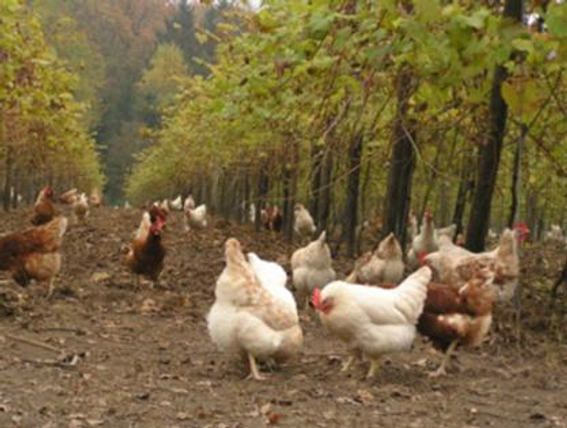
Chickens and hens particularly thrive within tree systems. They can hide under trees, find more bugs to eat and they perform substantially better in growth and health. And ammonia from their dung is absorbed by the tree canopy preventing it becoming air pollution.
Extending the grazing season
Trees can make a real difference to soil trafficability and grazing days. Farmers and trials are seeing that ground stays firmer under trees in wet periods and soils dry out more quickly after heavy rain, grazing can start earlier in spring and continue later into autumn.
In long-term silvopasture trials at AFBI, this has added weeks to the grazing season, reducing the need for housing, slurry handling and bought-in feed.

Photo: Fred Farelly
Climate resilience: coping with extremes
Trees help farms cope with both ends of the weather spectrum. They can reduce soil temperature and moisture loss during dry spells, slow water movement and improve infiltration during heavy rain, reduce wind damage and storm impacts.
Wide-spaced trees in agroforestry systems tend to develop strong, independent root systems, making them more resilient than closely planted woodland.

Tree fodder and animal nutrition
Some tree species can provide useful supplementary fodder for livestock.
Farmers are particularly interested in species like willow, ash and alder because leaves contain useful minerals and trace elements, browsing adds dietary diversity, animals self-select what they need.
Willow leaves contain good levels of Zinc and Cobalt, both of which are important for animal health but, cobalt in particular is very important for growing lambs. The bark contains salicin which is a precursor that allows the body to produce salicylic acid, a natural form of Asperine which has anti-inflammatory and pain relieving properties, and has been used for centuries for just this purpose.

How trees can fit into real farms
Trees don’t have to mean large-scale planting.
They’re being integrated through
-
silvopasture (widely spaced trees in grassland)
-
shelter belts
-
hedgerows
-
clumps or rows to suit field shape and stock type
Some systems are created by
-
thinning existing woodland,
-
respacing scrub or natural regeneration
-
planting directly into grassland
The most successful examples are designed to fit the farming system, not the other way round.
Learn more:
If you want to go deeper, here are some useful links:
Download: The Magic of Trees for Livestock — Jim McAdam (ORFC 2025) JIM MCADAM
Explore GrowIN videos on agroforestry and silvopasture
Join the GrowIN WhatsApp discussions
This is a fast-moving area, and we’ll continue to add examples as more farmers experiment and share what they’re learning.
