

Water
This page shares practical approaches from farm walks, trials and farmer conversations — focused on what you can do in practice with links to useful resources and support.
Thinking like a fish...nature based solutions for Lough Neagh
Download our presentation on simple, low cost solutions that can be implemented on farms, as presented at Oxford Real Farming Conference 2026
Visit the Water Innovation Network project website
Checking water quality
One of the simplest ways to understand how a stream or burn is doing is to look at what’s living in it.
No need for testing gear or labs, just lift a few stones in shallow, flowing water and see what you find.
It's useful to check the same spot over time — and compare upstream and downstream of yards or fields.
Find a stone about the size of your hand and turn it over to see what bugs are lurking.
Compare what you find against the images below.
-
If you find bugs from all sections or at least one from the green ‘Very Good Water’ cards – fantastic – the water is very clean.
-
If you find none from the green section but at least one from the orange ‘Good Water’ cards then the water is doing OK – but could be better.
-
If you only find invertebrates from the red section – there is a pollution problem. Have a look at our page on what to do next.
Never wade more than ankle deep. Never go in during a flood. Children should be supervised. Always wash your hands afterwards.


The Biotic score is a way of rating the water quality at any site based on the presence of indicator invertebrates.
The most tolerant, like bloodworms, get a score of 1.
The most sensitive like stonefly nymphs get a score of 10.
Alarm bells
Bloodworms
Often show up as red or pink blotches on the river bed.
They cope well with low oxygen and can point to organic pollution.


Sewage fungus
A grey-brown, slimy coating on stones or plants.
It can appear where nutrient-rich water enters a stream.
Gold star
Healthier streams usually support a wider mix of life.
Finding a range of different species is often more important than spotting one “perfect” indicator.

Cased Caddis
Cased caddis larvae build themselves little protective cases out of sand, tiny stones or plant bits.
Finding them usually means the stream has decent oxygen levels and isn’t being smothered by fine sediment.
They’re a good sign that the bed of the stream is still functioning as it should..

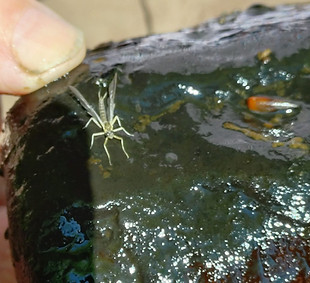
Stonefly nymph
Stonefly nymphs are one of the clearest signs of a healthy stream.
They need clean, cold, well-oxygenated water and tend to disappear quickly if conditions deteriorate.
Seeing them usually means the stream is doing something right.
Managing yard water
One of the simplest wins on many farms is stopping clean water from becoming dirty in the first place.
A lot of nutrient loss happens not because of big failures, but because:
-
clean spring or roof water runs into yards
-
silos are left uncovered
-
rainwater picks up manure and soil
-
everything ends up treated as “dirty” by default
Things farmers are doing in practice include:
-
diverting spring and roof water away from yards
-
covering silage pits
-
clearly separating clean and dirty drains
-
reducing the volume of water entering slurry or dirty water systems
Keeping clean water clean reduces risk, lowers pressure on storage, and makes any downstream treatment much more effective.
This is often the first thing farmers tackle — and it usually makes the biggest difference.
Slowing the flow with swales
Rather than trying to treat water at the very end of the system, some farms are slowing it down before it reaches a watercourse.
Swales are shallow channels or trenches designed so water flows slowly rather than rushing,
it drops sediment along the way as it moves through the system in stages.
In practice, farmers are using gentle slopes controlling water levels with simple pipes, adapting designs to suit their own yards and soils. Some swales are open; others are filled with stone so land can still be productive. These systems are usually low-cost, low-tech, and designed to suit the farm and the farming system.
These swales, or simple dug out bunds, can also act as an emergency reservoir in the event of a spill, positioned downhill from risk areas like above ground slurry stores.

Comfrey & willow to capture and re-use nutrients
Recycling nutrients instead of losing them
Plants like willow and comfrey are being used to turn nutrient loss into something useful.
They’re particularly suited to wet or awkward ground, the edges of swales and drains, places where water regularly flows.
Comfrey puts down deep roots and pulls nitrogen, phosphorus and potassium up into the leaves.
Willow copes well with wet ground and produces useful biomass.
Farmers are harvesting comfrey for liquid fertiliser, compost or mulching willow for biomass, fodder or shelter, bringing nutrients back into the farm system rather than losing them downstream
Used together, these plants help with water quality, biodiversity and resilience — while still fitting into working farms.
